12th September 2025 | Published in Italian on ‘Il Passo Giusto’ | Revised in January 2026
Sound archive ‘LA VÎA’, Silisia valley, 2025
The inaugural stage of the IX edition of the Dolomiti Mountain School was much more than an event on topics close to my heart: I had both the pleasure of overseeing the organization in the role of a local administrator and the honor of sharing my personal and professional story.
Telling one’s own story at a conference about a UNESCO World Heritage site made my voice tremble, even though I thought I was more prepared to publicly recount these last six years spent in the highlands. Amid data and studies presented by other speakers on the theme “Escapes, returns, and expectations: how the population is changing,” I had nothing but images, doubts about my graphic and existential choices, and a speech about the normality of living up here.
Certainly, I am a migrating soul: born in Tuscany, having lived across much of Europe since childhood, and ending up in a Eurasian megacity with a job in the field of technological innovation. And, one year before the pandemic, I decided to leave a respectable career to pursue three goals: to live better, to build a new family, and to rethink my role in design. Situations increasingly common nowadays.
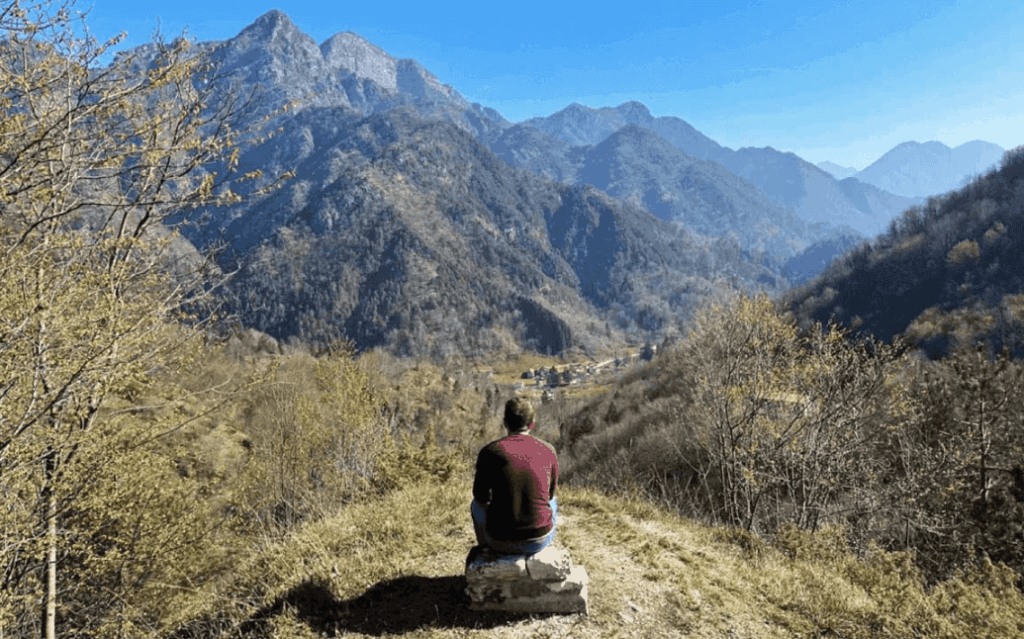
Perhaps, the fact that I focused these intentions on the Silisia valley, an almost uninhabited area of the main Tramontina valley, must have sparked some extra curiosity, enough to justify my presence at the event.

Effects of the storm on a utility pole, Staliros, 2023
I chose the mountains because I consider them a unique environment for maintaining good health, fostering inner reflection, and stimulating my creativity. The opportunity to live in the challenging and wonderful places of my partner’s origins has cemented my professional inclination to seek solutions to challenges alongside an equally personal and profound need for harmony.
When I talk about all this, or when I receive visitors in our isolated little house, the recurring word I hear is “courage.” To me, frankly and humbly, it seems like the most normal choice I could have made after years of frenzy and discomfort in an increasingly chaotic and unsustainable world. Over time, I have also understood that, to better comprehend these choices, it can be useful to know my new surroundings.
Uninhabited for millennia and colonized only from the 16th century onward, these areas were exploited without control: fires to promote grazing, timber traded with Venice; forests quickly gave way to barren lands. Minimal income, improved living conditions, and a relative population increase led to a progressive depletion of natural capital. The valley became difficult to live in, forcing many to emigrate as early as the beginning of the 19th century. When, in 1963, a hydroelectric basin reshaped the geography by submerging villages and the little arable plain, the diaspora was complete. Today, wilderness has reclaimed almost all the slopes and entire hamlets; a disaster for some, a paradise for others.
Living in Val Silisia means being surrounded by a constant reminder of what can go wrong when we impose human priorities on nature, and how nature takes back control without much concern for us, who meanwhile endure hardships, struggles, or escapes. But above all, it means being immersed in an open-air laboratory where one can reflect and act differently, in balance with ecosystems that are regenerating.
I consider my days in these places as part of a research project on the relationship between people and the natural environment, on the future of fragile contexts, and on the role that more attentive and systemic design can play in maintaining balance and contributing to well-being.
After a first year of settling in, I decided to give back to the valley: I co-founded a hyper-local no-profit organization, that is working toward a new concept of territory to be achieved by 2041: a wild garden where people live at low density, immersed in beauty; with entire portions ideologically abandoned, where the perception of natural evolution becomes a fascinating element. Where others see misery and nostalgia, we strive to build a desired future of coexistence with the wild.
Today, also thanks to the commitment of the Municipality of Tramonti di Sopra, the non-profit organization manages a former mountain school transformed into a hub for design, sciences, and arts applied to the valley. The many issues and challenges addressed within the association and in the territory have also influenced my paid work: gradually, I have preferred engagement with local entities and organizations over consultancy activities with large foreign companies.
This is how the multidisciplinary studio I direct came to life; we specialize in territorial regeneration, with a particular focus on rural and mountain areas.
Lastly, chronologically speaking, I had the privilege of being chosen as the Councillor for Environment, Territory, and Transition for my municipality, allowing me to help chart a course for the future of these lands.
Many fronts, different roles, but a single approach: creative and collaborative action.
A non-solution
The mountains’ issues, in fact, are a wicked problem – difficult to define and impossible to solve with a single solution; because the requirements are contradictory, incomplete, and constantly changing. And trying to tackle them often creates new problems.
Addressing it successfully requires a change in mindset, a touch of boldness, and collective dynamics: continuous intervention, actively involving people in decision-making processes, and letting go of the idea of a perfect solution. Accepting that new actions will always be necessary, that many results will come slowly or perhaps never, and that failure will be part of a learning and growth process more important than today’s product.
Marginality, in this sense, is a resource: it forces design humility, the building of alliances, and an impact assessment based on new values.
Only by moving away from 20th-century ideas and 19th-century models—which we still use—and with the perseverance and humility of the small concrete steps taken by those who have always lived here, can we truly hope for a better future.
To experiment, to persist, to believe. Which, in the end, is just a way of living.